Finding Joy and Purpose Through New Hobbies and Skills
Aging doesn’t mean slowing down your spirit. It means shifting gears into new passions, diving into interests you might have put on hold for years. Today, the online world and social circles offer endless opportunities to explore, create, and connect, and they’re not just for younger folks. By picking up a new skill or hobby, you’re not only keeping your mind sharp and body active but also opening doors to joy, creativity, and new friendships.
Embracing New Beginnings with a Musical Instrument
When you learn to play an instrument later in life, you invite music into your daily routine in a deeply personal way. The act of learning chords, melodies, and rhythms works your brain like a puzzle while also improving coordination and patience. Whether you choose the guitar, piano, ukulele, or even a digital keyboard app, this hobby gives you a structured challenge that rewards persistence with beautiful results. Joining a local jam group or an online forum adds the social lift many crave in retirement.
Breathing Life into Creativity with AI-Generated Art
Technology and imagination come together when you explore the world of AI-generated art. You don’t need to know how to draw or paint—just bring your ideas and a willingness to experiment. AI painting tools for art lovers allow you to create digital artworks by inputting simple text prompts, transforming your thoughts into images that emulate traditional mediums like watercolor or oil painting while also allowing users to make adjustments to style, color, and lighting effects. It’s a fresh way to express yourself, blending the magic of old techniques with the innovation of the digital age.
Bending, Stretching, and Breathing with Yoga and Tai Chi
Finding peace in movement is one of the most powerful forms of self-care. Yoga and Tai Chi offer gentle ways to stay active, improve balance, and manage pain without placing stress on aging joints. These practices also emphasize mindfulness and breathing, helping you reduce anxiety and feel more centered in your daily life. Whether you follow a YouTube channel or join a local senior-friendly class, the benefits ripple far beyond the mat.
Cultivating the Earth and the Spirit through Gardening
Gardening is a physical hobby that sneaks in exercise while grounding you in the rhythms of nature. Digging, planting, and pruning all engage your muscles and get you moving outdoors, where the fresh air can lift your mood. It’s also incredibly satisfying to see your labor bloom into herbs, vegetables, or flowers that nourish your body and brighten your space. Community gardens or neighborhood plant swaps turn this solitary hobby into a shared one with meaningful conversation and connection.
Clicking into Focus with Photography Adventures
Photography teaches you to see the world differently, even if you never leave your backyard. With just a smartphone or a basic digital camera, you can start capturing details and moments that bring beauty into focus. Online tutorials guide you through composition, lighting, and editing, while photo walks or contests inspire you to keep exploring. Over time, you’ll develop a visual diary that helps you appreciate life’s small joys and share them with others.
Bridging Cultures and Minds with a New Language
Learning another language in your golden years is not only possible but also incredibly enriching. It forces your brain to form new connections, boosts memory, and even delays cognitive decline. Whether you dream of visiting a new country or just want to chat with a neighbor in their native tongue, platforms like Duolingo or Babbel make it fun and accessible. Language meetups, even virtual ones, provide a social spark and a chance to laugh through mispronunciations together.
Knitting, Quilting, or Embroidery
Textile crafts engage both your hands and your mind in repetitive, soothing motions that reduce stress and improve fine motor skills. Whether you’re stitching a quilt for a grandchild, knitting a cozy scarf, or creating embroidery art, you’re creating something both useful and beautiful. These hobbies are easy to start with kits or tutorials and thrive in group settings like knitting circles or craft meetups. Each completed project offers not just satisfaction, but a tangible symbol of time well spent.
There’s something uniquely powerful about choosing to learn something new when others expect you to slow down. Whether you pick up a paintbrush, plant a seed, or master a digital tool, every new skill expands your sense of what’s possible. These hobbies are more than pastimes—they’re paths to better health, richer relationships, and a deeper appreciation for the present moment. Your next chapter doesn’t have to be quieter, just more colorful, more connected, and filled with purpose.
Ready to Rock your Lifestyle? Discover tips and insights for a vibrant retirement at Rock Your Retirement and become a true RRocker today!
This episode takes you back on the 30th of January 2019, where I was a guest on Reverend Barbara Williams’ BlogTalkRadio. In this episode, we talked about Life and Retirement and all the things you need to do in order for you to live a life with ease. BlogTalkRadio is an audio web-based platform that allows anyone to create live and on-demand talk content on the web. If you’re a radio broadcaster at heart, BlogTalkRadio gives you the ability to go live with its web-based studio and host multi-participant broadcasts using just a computer and a phone.,
Motivation for Writing My Journal
I was a retirement planner for a good 25 years, and I noticed that retirement and having a good life is not just about money. The people I’ve worked with and all the financial advisors at that time all spoke only about money. So, I thought about what I could do. That is why I started the Rock Your Retirement Podcast back in 2016. After which, I started interviewing people and what I’ve found that there are actually six areas of life that make a good life and retirement.
These are:
Spiritual
Significant Other
Friendship
Purpose in Life
Family
Health
In the journal, people actually track these areas every day. You would give yourself a small goal each day. The first thing you would do is write down in the morning something that you’re grateful for. A visiting pastor from a congregation I kept on finding things you are grateful for said that, start the first day with something that starts with a letter A, and then on the next day finding something with a letter B. For example, let’s say on the first day, you’re grateful for Apples and on the second day, you’re grateful for the bench that you sit on in the park. And on the third, you’re grateful for cantaloupe. So, that’s kind of a good way to try to remember what you’re grateful for. This journal is not meant to spend hours on, it’s meant to be something quick in the morning and quick in the evening. Then you write a goal in either all six of the pillars.
How Can You Be Happy with Life and Retirement?
From the Rock Your Retirement Show, I’ve interviewed so many people. Basically, what you have to do is you have to build that support system before you retire. But if you’ve already retired, and it’s too late to build that support, don’t worry, you could still build a support system but it really helps to start getting friends outside of work a year or two before you retire. One way that many of my guests have done this is through a website called Meetup.com. Sign up for a free account there and with that account, you can find meetups that are in person. Even though the program is online, you’re actually meeting persons. After that, you can search for something that you enjoy. Let’s say you like to hike, or bicycle, or garden, or like to read, these types of activities, there are other people in your city that like to do it to.
Social and Family Issues
We all have family issues. It’s hard because you don’t pick your family. God sorts of pick who your family is going to be and we all are there in the same house at one point but we all have our different perspectives.
I am not the expert at this, but that is why I try to make a little short goal every day of how I am going to be better.
Keeping Your Parents Safe at Homes
When I say keeping your parents safe at home, I’m talking about when they get too elderly, when things become dangerous for people to live by themselves. For example, in my generation, we have a lot of kids that are in college that we are still kind of supporting maybe not financially but emotionally and we have parents that are getting elderly, getting frail, they might have Parkinson’s disease or dementia. So, that is part of family issues as well. Trying to keep your family safe.
Life and Retirement: What People Need to Know Before Facing It
Before you retire, you need to know that depending on the type of job that you have, it might not be all roses. You might be busier in retirement than when you were working but unless you have something that is your purpose that you can replace that feeling of working, you might have problems adjusting. For some people their purpose is their grandkids, for some is their volunteer work. You have to figure out what your purpose is in life and retirement. God put us on Earth to do something. What is that something that God put you on Earth to do?
Sex
I had a guest on my show who said that anybody can have sex. Even if you physically can’t do it, we still need that physical touch and that physical connection that we get when we have sex. It doesn’t matter how old you are and it doesn’t matter if you’re frail. There are ways for you to have a sexual connection. Sex is a very important part of our life and when God gives us bodies to enjoy. He didn’t give us bodies to go out and desecrate them, but He gave us this body that we are supposed to enjoy with our life partner.
I wanted to let you know what the future is for the Rock Your Retirement Show.
If you have listened to the episode where I discussed my traumatic event, you’ll remember that I’m re-evaluating my life. This event was life-changing for me. If you haven’t listened to the episode, and you are interested, just go to Episode 209
Since this traumatic event, I decided I wanted to scale back on some of my workload. I have already announced to my remaining financial planning clients that I’ll be retiring from financial planning on 12/31/2020. Although I partially retired from financial planning in 2015, I continued to work with my favorite clients.
With Covid-19 affecting so many of our lives, I’ve had additional time to reflect. In my time of reflection, I have discovered that I need to make some further changes. And those changes affect the show.
Since 2016 I have been paying to host the show. Although I’ve added some advertising it has never supported the show. In fact, my affiliate link provider has indicated to me that I’m not getting enough click-throughs, so they want to start charging me as well! So, if I continue to run ads it will actually cost me money!!
It has been a tough choice however, I have decided that after we run all the shows we’ve already recorded, I’m going to take a break and we will stop doing our weekly episodes. It costs me about $150 per month to keep the show going, and my revenues are nowhere near that amount.
The only way I can continue on a regular basis is to get some listener support. You can support the show at a $3 per month basis if you’d like. If a small percentage of my listeners did this, then I will get the $150 I need to continue weekly episodes beyond 07/06/2020 when our last weekly interview is scheduled to be released.
Don’t worry though, even if I don’t get the support I need to continue on a regular basis, I’ll still pop in sporadically to tell you how I am doing. So, stay subscribed so you get the notifications.
This is a continuation of our one year project. If you are a new listener to the show, we do have a lot of back episodes where you can search and find information that you’re looking for starting with Episode 239.
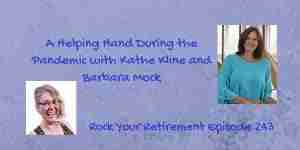
Today, my co-host Barbara Mock and I talk about something that she’s struggling with. Barbara is a grandma and she has seen the struggles that young families are having. She works through her feelings and her ideas on how she can help her own children and grandchildren deal with the pandemic. Perhaps listening to this bonus episode of the rock your retirement show can give you some ideas as well.
Online Class Struggles
In a time of the COVID pandemic, it’s really causing you to think about what to do every day. One of the things that everyone’s been struggling with is the fact that kids are not in school for the most part. So what Barbara did was that she planned and took off a week’s vacation to go help with my two grandchildren. getting them started with online school. Barbara wasn’t sure what to expect but she loves kids.
Barbara loves teaching but it was so hard to walk a mile and her daughter’s shoes. You’ve got a first grader and a four-year-old. She was so exhausted, it was difficult for her grandson, but he soldiered through. Constantly getting kicked off of the Zoom call. It just wasn’t what Barbara consider to be the best learning environment. She realized being in three places, as a mom, doing the groceries, going to work, keeping these kids occupied, and trying to educate them. It’s just almost more than a person can bear.
While Barbara was happy to help her daughter with the kids, it felt kind of sad, to turn around and go home. And there she was, working through it. But it’s been very, very difficult. That is why Barbara has empathy for young moms.
We’re All Feeling Stress During this Pandemic
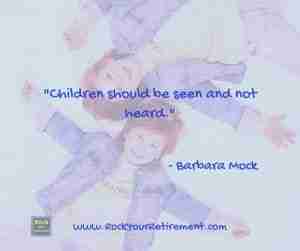
it’s easy to kind of have the old adage of children should be seen and not heard because kids need to move and they need to laugh and they need to sing. During this time, we’re all feeling stress and we’re underestimating it. We all manifest that stress or deal with that stress in many different ways. Some of us lash out, some of us are irritable, some of us are withdrawn or depressed.
Kids on the other hand have a hard time putting this in any sort of logic. When they see their parents or grandparents being stressed, a lot of times those meltdowns are just their way of trying to cope. They don’t have the ability or the skills that we have to hide it. Sometimes I think we should just scream just to let it out. But kids do say that.
Having Time to Help Out Through This Pandemic
Retirees have the opportunity to help this generation through this pandemic time by just being creative. Not saying you know, jeopardize your life, but certainly, with a mask, social distancing, just doing things outdoors, or even just helping out saying, I’ll pick up a pizza and deliver it. There are just so many things, that we weren’t in the habit of doing. We need to kind of change it up a little bit, just to provide that extra encouragement and support for these young women are facing.
It’s time for us, as parents, grandparents friends, to step up and maybe stand in the gap just a little bit safer, to help these kids and these grandkids.
For years, your calendar may have revolved around meetings, deadlines, kids’ recitals, or packed commuter trains. But now, the world opens a bit differently. Retirement offers you something you’ve probably lacked for decades—time. And for many, that time sparks an unexpected itch: to return to school. Whether you’re chasing a long-delayed degree, learning a language, or simply feeding a restless mind, going back to class post-career can be a rich, revitalizing chapter. But it’s not a decision to make lightly. Your motivations, resources, and lifestyle all factor into how (and if) you make that leap.
Revisit Why You Want to Learn
You’re not the same person you were at 22—and thank goodness for that. Before you start browsing course catalogs, ask yourself: what are you hoping to get from this? Some retirees return to school to complete an interrupted degree. Others want to pivot into new volunteer work or side gigs that require updated skills. Still others simply want mental stimulation, plain and simple. If your goal is career-related, your course choices may look different than someone who’s learning for the joy of it. Be honest. Your “why” will be your compass when the coursework gets heavy or when life’s distractions (ahem, grandkids) tug at your schedule.
Explore the Benefits of Online Degrees
The appeal of earning an online degree during retirement lies in its unmatched flexibility and accessibility. You can study from home, work at your own pace, and explore subjects that align with both your personal interests and professional aspirations. This model allows you to engage in higher education without disrupting your travel plans, volunteer commitments, or cherished downtime. If you’re looking to sharpen your leadership instincts or step into consulting roles, a Bachelor of Business Management can help you build a solid foundation in operations, strategy, and project oversight.
Map Out the Time Commitment
You may not be punching a clock anymore, but that doesn’t mean your time is wide open. Volunteering, caregiving, travel, or even just your long walks and coffee dates still deserve space in your calendar. So take a sober look at how much time you can realistically devote to lectures, readings, projects, and maybe even exams. Online programs tend to be more flexible, but even they require structure and discipline. You’re not cramming for a grade anymore—you’re managing your time so learning can stay a joy, not a chore.
Weigh the Financial Tradeoffs
Tuition isn’t cheap, even if you’re only auditing classes. While some community colleges and universities offer free or reduced tuition for seniors, you’ll still need to factor in books, tech, transportation, and other incidental costs. And if you’re considering a private institution, buckle up—those costs can rival your mortgage from the ’80s. Budgeting doesn’t mean nixing your dream. It means giving it the oxygen it needs to survive long-term. Don’t be shy about asking schools about senior discounts, audit options, or scholarships for non-traditional students. You’ve earned the right to ask.
Choose the Format That Fits Your Life
This isn’t about cramming into a desk between a pair of TikTok-savvy sophomores (unless that sounds fun to you—more power to you). Today, education lives online, on campuses, in hybrid formats, or even through weekend workshops. You’ll need to decide what feels energizing versus exhausting. Some retirees thrive on the social experience of an in-person class. Others prefer asynchronous formats where they can learn at their own pace, in pajamas, coffee in hand. Technology matters too—make sure you’re comfortable navigating whatever digital platforms your courses use. If you’re not, ask for help. This isn’t the time to pretend you’re fluent in Zoom if you’re not.
Talk to People Who’ve Been There
This is where real-life experience beats any checklist. Seek out other retirees who’ve gone back to school—friends, neighbors, online communities. Ask them what surprised them, what they’d do differently, what made the experience worthwhile. You’ll get a more nuanced view than any brochure can offer. Better yet, listen to voices that speak directly to this experience. One standout: Rock Your Retirement, a podcast where host Kathe Kline gets into the nitty-gritty of what retirement really feels like, beyond the travel brochures and sunset ads. Several episodes dive into lifelong learning, finding purpose, and rebuilding identity after leaving the 9-to-5 behind.
Keep Your Expectations Flexible
Education in retirement is a gift, not a second job. You’re not there to chase grades or impress anyone. Some courses may be harder than expected; some might not hold your attention the way you thought they would. That’s OK. Don’t be afraid to change tracks midstream or pause if life throws you a curveball. The beauty of this phase is that you’re the boss of your own learning. There’s no dean’s list, no GPA. Just curiosity, commitment, and the freedom to redefine success on your own terms.
Stay Curious, Not Competitive
It can be humbling to share a classroom with students who were born after the iPhone. But don’t let that throw you. You bring something invaluable to the table: lived experience. You’ve navigated crises, careers, kids, and culture shifts. That wisdom can enrich class discussions and inspire younger peers, even if your algebra skills are a little rusty. Just don’t fall into the trap of measuring yourself against others. Your goal isn’t to outscore anyone. It’s to grow—and maybe even surprise yourself along the way.
Reentering the world of academia later in life isn’t about chasing credentials—it’s about chasing meaning. And that’s a pursuit worth every book, lecture, and occasional eye roll from your classmates. Plan carefully, yes. Budget wisely. But let yourself dream a little too. Because education, at any age, isn’t just about what you learn—it’s about what it awakens in you. And if that includes a little homework? Well, maybe that’s not such a bad thing after all.
Ready to Rock your Lifestyle? Discover tips and insights for a vibrant retirement at Rock Your Retirement and become a true RRocker today!
Angie Strehlow who helps us get great guests that help us with our retirement lifestyle while keeping everything on track…and helps with these show notes!
Les Briney, my husband, who edits the show and makes my guests and me sound terrific.
Sharon Drury, who volunteers her time to work on transcription for us.
YOU for telling your friends about the show, leaving comments below, and sharing episodes you really like on Facebook, and reviewing the show on iTunes


 I wanted to let you know what the future is for the Rock Your Retirement Show.
 This is a continuation of our one year project. If you are a new listener to the show, we do have a lot of back episodes where you can search and find information that you’re looking for starting with